Bone Loss in Hypothalamic Amenorrhea: Can It Be Reversed?
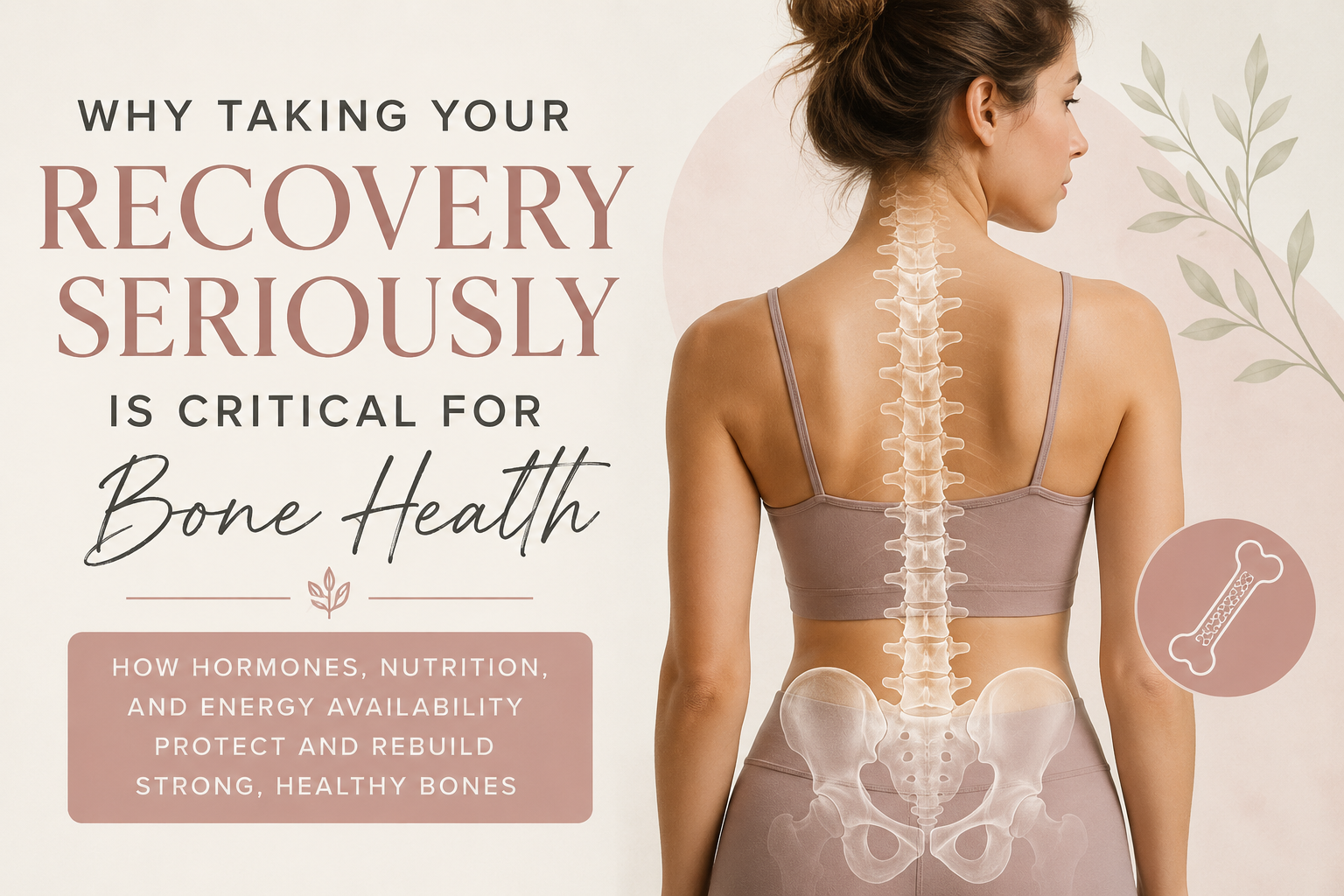
Hypothalamic amenorrhea (HA) doesn’t just affect your menstrual cycle. It can also significantly impact your bone health. This is especially important to understand if you're in adolescence or early adulthood, which is the critical window for building peak bone mass. Up to 90% of your bone density is typically established by your early 20s, and disruptions during this time (like those caused by HA) can interfere with that process.1,3
The good news is that the bone loss that occurs with HA can be managed and is preventable, especially if recovery happens early and is sustained. If you’ve had a DEXA scan and are worried about your results, take heart: with proper HA recovery, including restoring regular periods and nourishing your body well, you can rebuild bone and support long-term skeletal health.
To understand how best to care for your bones during recovery, it helps to first explore how HA disrupts bone-building processes and which hormones and nutrients are involved.
How HA Affects Bone Health
Bone is a dynamic, living tissue that undergoes constant remodeling—a process where old bone is broken down and replaced with new bone. This remodeling depends on two key cell types: osteoclasts, which break down bone (a process called resorption), and osteoblasts, which build new bone.2 Just like repairing and building muscle, this process requires significant energy, proper hormonal signaling, and coordination from the brain.
In HA, this balance is disrupted due to the suppression of the hypothalamic-pituitary-ovarian (HPO) axis, which alters the body’s normal hormonal signals. One of the most critical consequences is reduced estrogen production.3,4 Estrogen plays a key role in regulating bone turnover by slowing down bone breakdown and promoting bone formation. Without enough estrogen, the remodeling process shifts in the wrong direction. More bone is lost than replaced.3,4 Over time, this imbalance can lead to lower bone mineral density, making bones weaker and more prone to fractures—even in young women who may otherwise appear healthy.3,4
Estrogen: Your Bone’s Protective Hormone
Estrogen plays a central role in keeping bones strong and healthy. It helps maintain the balance between bone breakdown and bone formation by suppressing osteoclast activity (the cells that break down bone) and stimulating osteoblast activity (the cells that build new bone).5 One of estrogen’s key functions is regulating two important signaling proteins: RANKL and OPG. RANKL promotes bone resorption, while OPG acts as a blocker, preventing RANKL from activating bone breakdown. Estrogen increases OPG and decreases RANKL, helping to slow bone loss and support bone maintenance.4,5
When estrogen levels drop (as they do in HA) this balance is lost. RANKL increases, OPG decreases, and bone breakdown begins to exceed bone formation.2 Over time, this can lead to lower bone density.
Estrogen also supports collagen production, which is essential for the structure and flexibility of bone tissue.6 Without enough collagen, bones can become more brittle. This is why prolonged low estrogen levels can increase the risk of fragile, porous bones, particularly in the spine, hips, and pelvis especially during adolescence and early adulthood, when peak bone mass is still developing.3
The bottom line? Restoring normal estrogen levels by recovering your menstrual cycle is one of the most important steps you can take to protect and rebuild your bones now and in the future.3
IGF-1: The Unsung Hero of Bone Health
Another critical hormone for bone health is IGF-1 (insulin-like growth factor 1). Like estrogen, IGF-1 stimulates the development and activity of osteoblasts, the cells responsible for building new bone.4 This helps increase the number and function of bone-forming cells which is essential for maintaining and improving bone strength. IGF-1 also promotes collagen production,4 a key structural protein in bone tissue, and enhances bone mineralization by supporting the deposition of important minerals like calcium, phosphorus, and magnesium.9 These combined effects help make bones strong, dense, and resilient.
In HA however, IGF-1 levels are often low . This happens because, in a state of energy deficiency, the liver becomes resistant to growth hormone (GH) which typically stimulates the liver to produce IGF-1.7,8,9Interestingly, in HA GH remain high in an attempt to stimulate IGF-1, but because the liver becomes resistant to GH, it’s efforts are wasted. The result is reduced IGF-1 production, in the presence of normal/high GH. Low IGF-1 contributes to a decrease in bone formation, weaker collagen scaffolding, and impaired mineralization (all of which increase the risk of low bone density and fractures).3,9
When combined with low estrogen, this creates a perfect storm for bone loss. That’s why restoring hormonal balance through HA recovery is essential. Only when both estrogen and IGF-1 levels are restored can the body fully re-engage the powerful systems that protect and rebuild bone.
Cortisol: The Stress Hormone That Undermines Bone Health
It’s no surprise that cortisol, a major player in HA contributes to poor bone health.
When cortisol stays elevated, like in HA, it increases the RANKL protein (for bone breakdown), and decreases OPG (blocks RANKL). This shift promotes more bone breakdown and less bone protection. 10 On top of that, cortisol suppresses osteoblastactivity,3 reducing your body’s ability to build new bone to replace what’s being lost. Combined with low estrogen and low IGF-1, this creates a powerful drive toward weakened bone structure and reduced density.
Cortisol also disrupts calcium balance. It increases calcium loss through urine and decreases calcium absorption from the gut which is problematic, because calcium is a critical building block of bone. When calcium levels drop, the body compensates by breaking down bone to release stored calcium, further undermining bone integrity and slowing repair.3
Most significantly, cortisol acts to suppress HPO axis, leading to decreased production of key reproductive and bone building hormones.7,11 This hormone-suppressing effect amplifies the bone damage already underway and contributes to the hormonal cascade that makes bones more fragile.3,4 That’s why restoring energy balance, reducing stress, and reactivating the HPO axis through proper HA recovery is crucial to prevent bone loss and protect long-term bone health.
Undereating and Undernourishment: The Root Cause of Bone Loss in HA
HA is most often caused by relative energy deficiency (a state in which your body isn’t getting enough calories to meet its daily needs).7 This energy shortfall is the true root of the problem! Even if you’re not clinically underweight, undereating and under nourishing, especially when combined with intense exercise, can disrupt the production of key hormones like estrogen, IGF-1, and thyroid hormones.13 These hormones are not only essential for reproductive health; they are also critical for maintaining strong, healthy bones.
Women with HA often fall short on both macronutrients and micronutrients.13 Macronutrients (protein for tissue repair, carbohydrates for energy, and fats for hormone production and signaling) are all essential to support bone remodeling.12 At the same time, many women with HA also miss out on key micronutrients that bones depend on for strength and structure. These include:12,13
Calcium – Builds and maintains bone structure; deficiency increases bone breakdown
Vitamin D – Enhances calcium absorption and is essential for bone mineralization
Magnesium – Supports vitamin D activation and plays a role in bone turnover
Phosphorus – Works with calcium to harden bone
Zinc – Supports collagen formation and bone-building cell function
Vitamin K2 – Helps integrate calcium into the bone matrix
Bone remodeling is an energy-intensive process. Without adequate fuel, your body can’t maintain the hormonal balance needed to regulate this process or carry it out effectively. That’s why getting enough calories and nutrients from energy-dense, nutrient-rich foods is essential not only for hormone recovery but for protecting and rebuilding your bones.12 When your body lacks the energy and nutrition it needs, bone formation slows, remodeling is disrupted, and bone strength declines over time.
Restoring Your Period: The First Step Toward Stronger Bones
The most important goal in recovering from HA is to restore your menstrual cycle and ovulation which is a key sign that your hormones, especially estrogen, are coming back online and your body is starting to feel safe again.3,4 When this happens, your body begins to re-activate many vital functions it previously downregulated to conserve energy, including those that support bone health.
For your bones, this also means focusing on a nutrient-dense diet that includes the vitamins and minerals essential for bone repair and growth. While supplementation with calcium, vitamin D, magnesium, zinc, and vitamin K2 may be helpful in some cases, it’s best to get these nutrients through real food alongside adequate carbohydrates, healthy fats, and protein in order to support optimal absorption and overall recovery.13
Lastly, once your period has returned consistently and your energy availability is restored, supervised resistance training (not excessive cardio) can be a helpful way to stimulate bone remodeling and improve bone density.14 However, this should only be done under the guidance of a healthcare provider familiar with HA to avoid setbacks.
Bottom Line
Bone loss that occurs with HA can be prevented and managed, especially when recovery is started early and approached comprehensively. 4 That means eating more, exercising less, managing stress, and allowing your body the time and nourishment it needs to fully restore its hormonal function.4,7
Taking HA recovery seriously isn't just about preserving fertility. It's about protecting your strength, mobility, and quality of life for years to come. Seeking guidance from HA-aware specialists (such as dietitians, therapists, and physicians) can make a huge difference, helping you navigate recovery more confidently and take additional steps to support your bone health now and into the future.
Keep Reading
Beginners Guide: WTF, I Have HA?
I Eat Healthy… So Why Do I Have High Cholesterol and No Period?
Why GI Distress Happens in Hypothalamic Amenorrhea Recovery (And Why It’s Temporary)
Hypothalamic Amenorrhea, Low Estrogen, and Alzheimer’s Risk: Why Recovery Matters for Brain Health
Why AST and ALT Are Elevated in Hypothalamic Amenorrhea—And Why It’s Not Fatty Liver Disease
Author
This was written by Cat, a graduate of our Holistic HA Practitioner (HHAP) Certification Program. Cat brings a deep understanding of the root causes of HA and is passionate about supporting women on the path to recovery through education, empowerment, and holistic strategies.
References:
Benjamin, R. M. (2010). Bone health: Preventing osteoporosis. Public Health Reports, 125(3), 368–370. https://doi.org/10.1177/003335491012500302
Rowe, P., Koller, A., & Sharma, S. (2023). Physiology, bone remodeling. In StatPearls. StatPearls Publishing. https://www.ncbi.nlm.nih.gov/books/NBK499863/
Indirli, R., Lanzi, V., Mantovani, G., Arosio, M., & Ferrante, E. (2022). Bone health in functional hypothalamic amenorrhea: What the endocrinologist needs to know. Frontiers in Endocrinology, 13, 946695. https://doi.org/10.3389/fendo.2022.946695
Behary, P., & Comninos, A. N. (2022). Bone perspectives in functional hypothalamic amenorrhoea: An update and future avenues. Frontiers in Endocrinology, 13, 923791. https://doi.org/10.3389/fendo.2022.923791
Khosla, S., Oursler, M. J., & Monroe, D. G. (2012). Estrogen and the skeleton. Trends in Endocrinology and Metabolism, 23(11), 576–581. https://doi.org/10.1016/j.tem.2012.03.008
Florencio-Silva, R., Sasso, G. R., Sasso-Cerri, E., Simões, M. J., & Cerri, P. S. (2015). Biology of bone tissue: Structure, function, and factors that influence bone cells. BioMed Research International, 2015, 421746. https://doi.org/10.1155/2015/421746
Meczekalski, B., Katulski, K., Czyzyk, A., Podfigurna-Stopa, A., & Maciejewska-Jeske, M. (2014). Functional hypothalamic amenorrhea and its influence on women's health. Journal of Endocrinological Investigation, 37(11), 1049–1056. https://doi.org/10.1007/s40618-014-0169-3
Allaway, H. C., Southmayd, E. A., & De Souza, M. J. (2016). The physiology of functional hypothalamic amenorrhea associated with energy deficiency in exercising women and in women with anorexia nervosa. Hormone Molecular Biology and Clinical Investigation, 25(2), 91–119. https://doi.org/10.1515/hmbci-2015-0053
Locatelli, V., & Bianchi, V. E. (2014). Effect of GH/IGF-1 on bone metabolism and osteoporosis. International Journal of Endocrinology, 2014, 235060. https://doi.org/10.1155/2014/235060
Komori, T. (2016). Glucocorticoid signaling and bone biology. Hormone and Metabolic Research, 48(11), 755–763. https://doi.org/10.1055/s-0042-110571
Meczekalski, B., Niwczyk, O., Bala, G., & Szeliga, A. (2022). Stress, kisspeptin, and functional hypothalamic amenorrhea. Current Opinion in Pharmacology, 67, 102288. https://doi.org/10.1016/j.coph.2022.102288
Martiniakova, M., Babikova, M., Mondockova, V., Blahova, J., Kovacova, V., & Omelka, R. (2022). The role of macronutrients, micronutrients and flavonoid polyphenols in the prevention and treatment of osteoporosis. Nutrients, 14(3), 523. https://doi.org/10.3390/nu14030523
Dobranowska, K., Plińska, S., & Dobosz, A. (2024). Dietary and lifestyle management of functional hypothalamic amenorrhea: A comprehensive review. Nutrients, 16(17), 2967. https://doi.org/10.3390/nu16172967
Hong, A. R., & Kim, S. W. (2018). Effects of resistance exercise on bone health. Endocrinology and Metabolism, 33(4), 435–444. https://doi.org/10.3803/EnM.2018.33.4.435